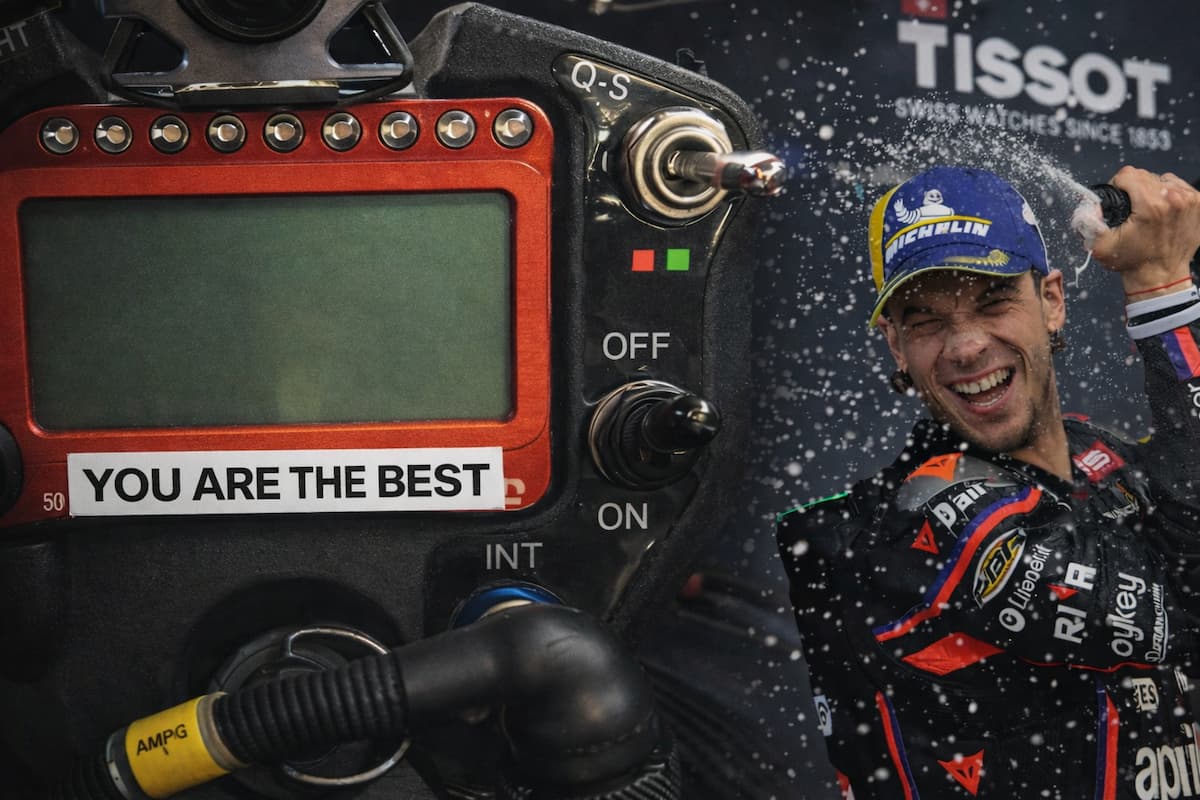
Eight years ago, in the paddock, I took a photo.
Just labelled under the dasdhboard, a simple phrase:
“You are the best.”
The rider was Marco Bezzecchi.
At the time, no one in the paddock would have called him the best of his generation. The lap times didn’t say it. The results didn’t either.
And yet, that phrase was there. Owned. Visible. Repeated every time he left the garage.
Years later, Bezzecchi became the author of the greatest domination in MotoGP history — in terms of consecutive laps led.
I’m not saying that phrase did everything.
But I will say it reveals something most athletes don’t understand about their own brain.
Your brain is not objective
We’d like to think the brain works like a camera.
It records. It analyses. It plays back.
That’s not what happens.
The brain is a prediction machine. Before you even consciously perceive something, it has already generated a hypothesis about what it expects to find.
And then it looks to confirm it.
This mechanism is called confirmation bias. It doesn’t only apply to political opinions or dinner table arguments. It applies to your athletic performance — hour by hour, session after session.
What you believe shapes what you see. What you see reinforces what you believe.
It’s a loop. And it runs continuously.
Attention as a spotlight
Think of your attention as a spotlight.
It can’t illuminate everything at once. It selects.
And what it chooses to illuminate depends largely on what you already believe.
If you believe you’re not at the right level
Your attention will naturally pick up on:
- trajectory errors
- sensations that feel off
- times below your expectations
- mistakes in training
Not because you’re pessimistic. Because your brain is searching for coherence with what it already believes to be true.
And it’s efficient. It finds what it’s looking for.
If you believe you’re improving
The same session, with the same objective performance, produces a different experience.
Your attention picks up on:
- adjustments that are working
- sensations that are getting sharper
- details that confirm your progress
This isn’t self-delusion.
It’s neurology.
The dead end of fixed beliefs
The problem isn’t having limiting beliefs.
Everyone does. Including me.
The problem is when they become rigid.
I’ve worked with highly skilled athletes who had been plateauing for months. Not from lack of effort. Not from lack of talent.
From perceptual rigidity.
Their belief about themselves had become an invisible ceiling. They could no longer see certain information. Not consciously — their brain was filtering it out before it even reached awareness.
A fixed belief doesn’t lie to you. It hides things from you.
It narrows your field of perception at the exact moment you need access to all your resources.
What Bezzecchi understood without articulating it
When I look at that photo today, I don’t see a rider telling himself stories.
I see an athlete who chose an internal direction.
Not “I am the best” as an empty affirmation.
But “I treat myself as if this direction is possible” — and he let his entire system align around that hypothesis.
It’s subtle. And it’s powerful.
Because a useful belief doesn’t tell you that you’ve already succeeded.
It opens your attention toward what allows you to grow.
Three questions to work on your beliefs right now
No complex technique required to start.
1. What do I repeatedly tell myself about my performance?
Not what you say out loud. What you think quietly before a session, after a mistake, or when facing a stronger competitor.
Write it down. Without judgment.
2. Does this belief open or close my attention?
Does it push you to look for resources? Or does it push you to find proof that your fears are justified?
3. What internal direction would feel credible to me, right now?
Not unrealistic. Not “I’m the best in the world” if you’re still finding your footing.
Something open. Evolving. That leaves room.
“I’m starting to understand this level.” “I can adapt here.” “There’s something to find in this difficulty.”
These are beliefs that work for you.
What I observe in my work as a mental performance coach
The athletes who progress fastest are not always the most talented.
They are often the ones who have a flexible relationship with their own self-image.
They can look at a mistake without turning it into an identity.
They can go through a difficult period without concluding it’s permanent.
That flexibility doesn’t come from willpower.
It comes from working on the structure of what you believe about yourself.
This is precisely what I work on with the athletes and executives I coach.
Does this article resonate with you?
Book a free discovery call to explore how mental performance coaching can transform your results. Book a call · 30 min · No commitment.
Cet article vous a intéressé ? Découvrez comment la préparation mentale peut transformer votre performance.
Réserver un appel découverte gratuit 30 min · Sans engagement